Office Clearance in Neasden
Office clearance in Neasden should make it easier to empty workspaces, remove old furniture and clear away general business items without turning the job into a disruption. Our service is built around practical removal work for offices, commercial premises and shared work areas, with attention to sorting, loading and responsible onward handling. If you need a neat, straightforward way to clear an office floor, we can help with a service shaped around the items and access at your site.
We handle a wide range of office clearance tasks, from removing desks, chairs and cabinets to clearing archive material, small electricals and mixed office contents. Where a property has more than one room, we can work through the space in an organised order, keeping the process manageable and avoiding unnecessary handling. For many customers, the aim is simple: clear the room cleanly and leave it ready for the next stage.
We also support enquiries that need a broader tidy-up rather than a single item removal, such as clearing reception areas, meeting rooms, storage cupboards or back-office rooms. Pricing and quotes can be discussed once the scale of the clearance is known, and you can use a plain enquiry if you prefer to outline the job first. Tell us what needs shifting, and we can help you plan the most suitable approach.
What our office clearance service covers
Office clearance usually involves more than lifting a few items and taking them away. It often includes separating furniture from loose contents, keeping reusable pieces distinct from items that need disposal, and making sure the route out of the building is handled carefully. That matters in offices where lifts, corridors, stairwells and shared entrances need to stay usable while the work is taking place. A well-run clearance should feel ordered, not rushed.
Our work can cover desks, task chairs, filing cabinets, shelving, tables, storage units and assorted office clutter. It may also include monitors, keyboards, printers and similar equipment where these form part of the clearance load. If the office has accumulated mixed items over time, we can help remove them in a sensible sequence so that the room can be emptied without creating extra handling problems. The service is designed to be practical for day-to-day business spaces, not just large corporate premises.
Common office items that may be included are:
- workstations and desk furniture
- office chairs, visitor seating and reception furniture
- filing units, shelving and storage cupboards
- mixed paperwork, archive boxes and loose contents
- small electrical items and redundant office equipment
Furniture, fittings and bulky items

Office clearances often turn on bulky furniture rather than loose waste. Large desks, cabinets, boardroom tables and shelving systems can take time to dismantle or manoeuvre, especially where access is narrow or the items have been in place for years. We treat these as part of the clearance plan, so the removal is organised around the size and shape of the furniture rather than forcing everything through a single process. That makes the job safer and easier to control.
Furniture clearance is useful when the priority is to remove usable or unwanted office furniture in an orderly way, while furniture disposal is relevant when the items are no longer needed and must be taken away as part of the clearance. Not every office contains the same mix, so the right method depends on whether the contents are mostly furniture, mostly loose materials or a combination of both. We can work with either type of load.
For customers replacing older interiors, a clearance may also include items that are fixed or semi-fixed within the room, such as shelving runs, screens, partitions in some settings and storage pieces that have become redundant. Where dismantling is needed, we focus on controlled removal so the remaining space is left in a condition that supports the next stage of work. If you are unsure what can be taken in one visit, a clear list of the items is usually enough to begin planning.
Offices, workspaces and business premises
Different premises call for slightly different clearance approaches. A compact office suite may only need a few key items removed, whereas a larger business unit may need several rooms emptied in stages. We can adapt the work to open-plan offices, back offices, private rooms, reception areas and storage spaces. The point is to clear what needs to go while keeping the job practical for the layout of the premises.
Business waste removal is a helpful option where the contents include mixed office waste alongside furniture and equipment. For sites with broader internal clear-outs, home clearance and house clearance may describe other parts of this website, but office jobs remain distinct because they tend to involve workplace fittings, commercial items and a different pattern of access. We keep the service focused on business use rather than trying to treat every building the same way.
Where an office contains storage areas, duplicated furniture or older records, the clearance can be planned around priority zones first and less urgent zones second. That helps when the room must stay partly in use while other sections are emptied. If you need the clearer result rather than the detailed process, the goal is still straightforward: a professional office clearance that removes what is no longer required and leaves the space ready for reuse, handover or refurbishment.
Planning a clearance in a sensible way
Access, sorting and timing
Good planning usually starts with access. Offices often sit above ground floor level, share entrances with other users or have parking and loading restrictions that affect how the clearance is handled. Sorting can also matter, particularly where some items are to be kept, some reused and some removed. A little preparation around these points helps the work run in a more orderly fashion and reduces the chance of confusion on the day.
Two details are especially useful when arranging an office clearance: a simple rundown of the rooms involved and an indication of any bulky items, access limits or awkward stairways. If the site is still operational, it also helps to know which areas must remain undisturbed. Clear instructions at the outset usually make the whole task easier to organise, and they can also help with an accurate quotation. If you are ready to go, you can ask for a quotation with the room count and main items included.
Compliance, handling and onward processing
![A male worker dressed in a high-visibility safety vest and white hard hat is standing outdoors on a grassy area, holding a white window frame with glass panels. Behind him, several other window frames with various finishes and textures are stacked upright against a chain-link fence, which forms the background of the scene. The window frames are made of wood or uPVC, exhibiting smooth surfaces and neutral tones, with some frames leaning slightly or stacked in front of others. The environment appears organized and indicative of a rubbish removal or clearance activity typically associated with property or office clearance services in Neasden. The ground shows part of a driveway or pavement, with additional loose window parts lying in front, suggesting ongoing clearance or loading activities. The natural lighting highlights the textures of the glass and frame materials, creating a professional and factual snapshot relevant to rubbish removal services on the [POSTCODE] area.](/pub/_photos/rubbish/f1227931096.jpg)
Office clearances often include items that need careful handling beyond simple lifting. This can include electronic equipment, mixed office contents and paperwork that should be sorted before removal. We approach the job with an eye to practical handling and responsible onward processing, so the clearance is not just about making space but about dealing with the contents in a sensible and orderly way. That is especially important where the load contains a mixture of furniture and smaller items.
Recycling and sustainability is relevant where the office contents include materials that can be separated for further processing rather than treated as one mixed pile. For customers who want reassurance around the care of the work, insurance and safety gives another part of the picture. These pages are useful when you want to understand how the service is run and what sits behind the clearance process, particularly for more involved jobs.
We do not treat every clearance as identical. An office with a few surplus desks, for example, needs a simpler approach than one with archive storage, multiple filing systems and several rooms of mixed content. The right method depends on the layout, the volume and the type of items present. That is why office clearance is usually best discussed against the actual premises, rather than assumed from the building type alone.
Neasden and the surrounding area
Neasden is an area in northwest London within the London Borough of Brent, known for a mix of residential streets, transport links and busy local roads. The area sits close to important routes such as the North Circular Road, and its identity is shaped by both long-established housing and more recent development. Neasden’s name is also associated with the surrounding district of the same name, which has a wider reach than just one street or estate, so it is often understood as a local centre rather than a single neighbourhood in isolation.
One of the best-known landmarks is the nearby Wembley area, but Neasden itself has distinct places of interest, including the BAPS Shri Swaminarayan Mandir, a major Hindu temple in London completed in the 1990s and notable for its carved stonework and prominent cultural role. The area also includes Neasden Recreation Ground and links towards Gladstone Park, giving the district open green space as well as roads and housing. Much of the built environment is a blend of terraces, apartment blocks and commercial premises, reflecting the evolution of northwest London over the twentieth century. Neasden’s position near major transport corridors has made it an accessible part of Brent, while still retaining a local character shaped by its streets, places of worship and everyday urban life.
Household-style clearances for offices and mixed premises
Some office clearances overlap with other kinds of property work, particularly where a business is based in a converted house, a small managed unit or a mixed-use building. In those cases, the contents may include items more commonly seen in domestic settings as well as office furniture and equipment. We can still approach the job as an office clearance, but the method may need to take account of softer furnishings, mixed storage and different room layouts. That flexibility helps when the premises do not fit one neat category.
Flat clearance, garage clearance and loft clearance are relevant service pages where storage or mixed contents need removing from tighter or less conventional spaces. Although those services are not office clearances themselves, they show the sort of varied removal work that can matter when a business occupies a complex building. If your premises combine work areas with storage or an upper-floor room, the clearance can be planned to suit the actual layout instead of forcing a one-size-fits-all method.
For many customers, the key decision is whether the clearance should be handled room by room or as one coordinated job. The answer usually depends on access, the volume of contents and how quickly the area must be emptied. Either way, the service remains focused on careful removal, sensible sorting and leaving a cleaner, more usable space behind.
Why different clearance types are sometimes combined
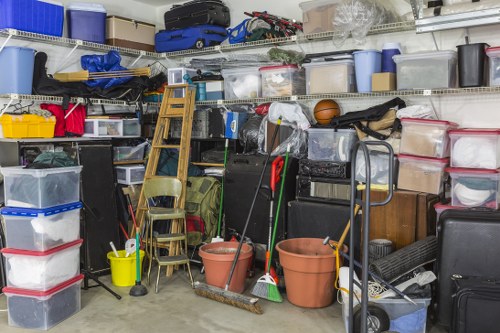
Office spaces often build up a mixture of contents over time, which is why one type of clearance alone may not fully describe the work. A room may contain desks, filing cabinets and chairs, but also boxes from storage, old household-style furniture in a small business unit, or building-related waste from a fit-out. Combining the right service elements can make the job more efficient, provided the items are dealt with in a controlled and organised way.
Builders waste clearance is useful when an office job includes leftover materials from alterations, refurbishment or strip-out work. Where the task is simply to clear general rubbish, waste removal may be the broader term, though office clearances usually need a more tailored approach because of the furniture and equipment involved. By matching the service to the contents, the work can stay clearer and more manageable.
Some customers want only a partial clearance, such as removing surplus filing cabinets or freeing one area for new use. Others need a complete emptying of the premises before a handover or refurbishment. Both are valid forms of the same general service, but the scale and content change the way the work is organised. That is why it helps to describe the room, the items and the access points as precisely as possible before the job is arranged.
Getting a quotation for office clearance
Quotation requests are usually easiest when they focus on the real job rather than a vague description. A short outline of the office size, the rooms involved and the main items to be removed gives a better basis for planning. If anything is especially large, fragile or awkward to move, mention it as part of the same enquiry. That way, the proposed clearance can be shaped around the contents rather than leaving important details to guesswork.
You can also help by noting whether the office is still in use, whether access is shared and whether there are any fixed items that need attention. These details are often enough to decide how the clearance should be approached and whether it needs to be split into sections. For direct contact, use the contact page and include the main items, the floor level and any time restrictions. If you are not ready for a full enquiry, a brief message is still a good place to start.
When you are ready to move ahead, ask for a quotation and let us know what needs clearing. A concise description is often all that is needed to begin. Start with the items, the rooms and the access, and the rest of the plan can follow from there. We will then look at the scope of the office clearance and help you work out the next step.
Working around furniture, equipment and storage

Office environments rely on furniture and equipment that can be bulky, repetitive or awkward to sort once it is no longer needed. That includes chairs, screens, cabinets, meeting tables, shelving and technical items that may have sat in storage for years. A proper clearance needs to account for the full load rather than just the most visible pieces, because smaller contents can take up as much time as the larger items once the work begins.
Office clearance is the main service page for this work, while about us and complaints procedure give further company information if you want to understand how the business is presented and how issues are handled. In commercial terms, though, the important point is that the clearance itself is arranged around the workplace contents, the building layout and the outcome you need. The job should feel structured from start to finish.
Whether the task is a single room, a suite of rooms or a full business unit, the result should be a clear and practical emptying of the space. You do not need to over-explain everything to begin; a sensible summary of the contents is enough. If you want to compare the pages and then proceed, you can ask for a quotation once the main items are identified.